The Culinary Wisdom of Our Ancestors
In an age of modern convenience, a connection to the elemental forces of cooking has been somewhat lost. While we value the precision of new technologies, a rich tapestry of ancestral cooking traditions offers a depth of flavor and a link to our heritage that modern gadgets cannot replicate. These methods, passed down through generations, are not historical curiosities but living repositories of culinary wisdom, demonstrating that the most profound results can arise from the simplest means.
1. Tandoor Cooking: The Fiery Heart of South and Central Asia
The tandoor is a culinary institution across South and Central Asia, using searing temperatures to produce charred, succulent, and aromatic foods.
The Anatomy of a Tandoor
A tandoor is a large, cylindrical clay pot that acts as an oven. A fire built at the bottom heats the oven’s walls to incandescent temperatures, often exceeding 480°C (900°F). The cooking process relies on a trifecta of heat: direct radiant heat from the embers, convective heat from circulating hot air, and conductive heat from the superheated clay walls. This intense environment cooks food rapidly, sealing in moisture.

The Tandoor’s Culinary Repertoire
The tandoor’s dry heat is ideal for breads and marinated meats. Dough for flatbreads like naan and roti is slapped directly onto the oven’s inner walls, where it bakes in minutes, creating a crisp exterior and a blistered, smoky surface. For meats like chicken tikka, marinated pieces are threaded onto long skewers and lowered vertically into the oven. The yogurt-based marinade protects the meat from the fierce heat, resulting in a tantalizingly charred crust and an incredibly moist interior.
2. Píbil (Pib): Subterranean Steam Cooking of the Yucatán
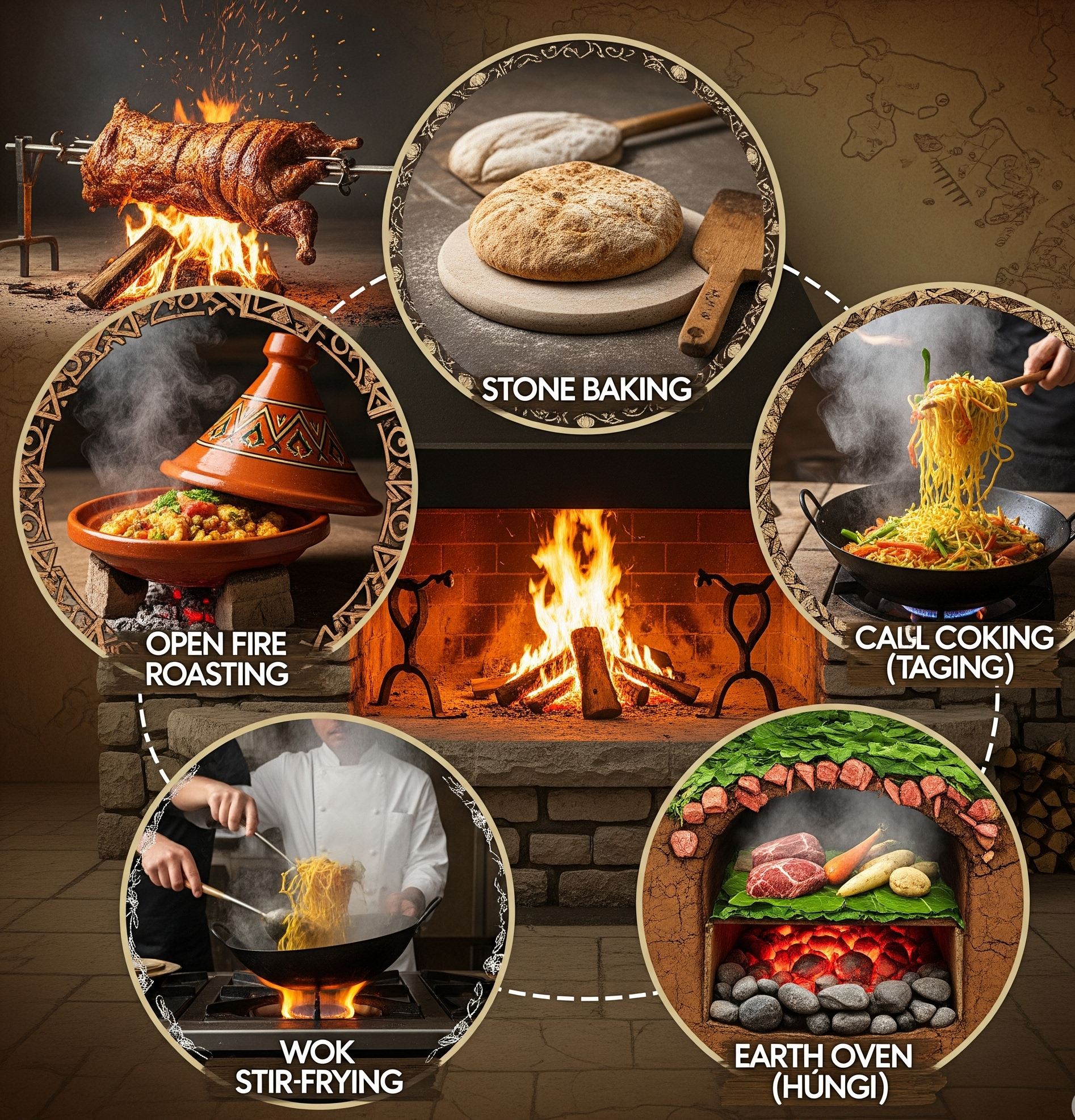
From Mexico’s Yucatán Peninsula comes Píbil, a Mayan technique of slow-roasting food in a subterranean pit, which transforms the earth itself into an oven.
The Earth as an Oven: Constructing the Pib
A pib is constructed by digging a pit, heating stones with a hardwood fire, and then placing the food—tightly wrapped in banana leaves—on a rack inside. The pit is covered with more leaves and sealed with earth, creating a subterranean pressure cooker. The food cooks for many hours in this hot, steamy, and smoky environment.

The Quintessential Pib Dish: Cochinita Pibil
The most celebrated pib dish is Cochinita Pibil. Before being buried, pork is slathered in a tangy marinade of achiote paste and bitter orange juice. The slow metamorphosis inside the pib breaks down connective tissues and renders fat, resulting in unctuously tender meat that is suffused with the complex flavors of the marinade, smoke, and banana leaves.
3. Tagine Cooking: The Aromatic Alchemy of North Africa
In North Africa, a tagine is both a conical earthenware pot and the succulent, slow-simmered stew cooked within it. This method transforms simple ingredients into an aromatic and flavorful dish.
The Ingenious Design of the Tagine Pot
The tagine’s success lies in its design. As the stew simmers, steam rises into the tall, conical lid, condenses, and drips back down, continuously basting the ingredients in their own flavorful juices. This cycle minimizes the need for added water and concentrates the flavors. The earthenware construction also ensures gentle, even heat distribution, perfect for tenderizing tough cuts of meat.

Crafting a Tagine: A Symphony of Spices and Slow Braising
Preparing a tagine involves methodically layering flavors. Ingredients are browned in the base before spices and liquids are added for a long, slow braise. A hallmark of Moroccan tagines is the sophisticated interplay of sweet and savory, often pairing rich meats with dried fruits like apricots and prunes, balanced by warm spices and the unique tartness of preserved lemons.
4. Nixtamalization: The Mesoamerican Transformation of Maize
Not all traditional techniques involve heat. Nixtamalization is a transformative Mesoamerican food processing method that dramatically enhances the nutritional profile of maize (corn).
A Process of Chemical and Nutritional Enhancement
The process involves soaking and cooking dried maize kernels in an alkaline solution, typically calcium hydroxide (slaked lime). This ancient practice softens the corn’s tough hull, making it easier to grind. Critically, it initiates a chemical reaction that releases niacin (vitamin B3), making it bioavailable and preventing the deficiency disease pellagra.

The Foundation of Mesoamerican Cuisine
The resulting nixtamalized corn, or nixtamal, is ground into a dough called masa. This masa is the soul of Mesoamerican cuisine, forming the basis for tortillas, tamales, gorditas, and sopes. The development of nixtamalization was a civilizational innovation, allowing maize to become a complete nutritional staple that sustained empires.
5. Asado: The Ritualistic Barbecue of the Pampas
In Argentina and across South America, asado is more than a meal; it is a cherished social ritual and the heart of the region’s culinary culture.
More Than a Meal: The Social Fabric of Asado
An asado is a slow-paced gathering centered around the asador, or grill master, who skillfully tends the fire and meat. The event unfolds over hours, emphasizing community and conversation. The core technique is cooking “a fuego lento” (over a slow fire), using the gentle, indirect heat of embers (brasas) rather than open flames.

The Technique: “A Fuego Lento” (Over a Slow Fire)
A separate fire is built, and its glowing embers are raked under the grill, or parrilla. The asador maintains a consistent, low temperature to slowly cook large cuts of meat, often for hours. The meat is typically seasoned simply with coarse salt, allowing the pure flavor of quality beef, kissed by smoke, to be the star.
Conclusion: The Timeless Relevance of Traditional Techniques
While modern kitchens offer speed, these ancient methods provide a connection to history, culture, and the elemental nature of food. Preserving these techniques is vital, as they are links to our culinary heritage. The flavors they create are not just tastes but stories—narratives of place and tradition, demonstrating that food is a powerful conduit for understanding culture.